
Name: Buck Rogers
Release Date: 1939
Writer: Dick Calkins (comic strip), Norman S. Hall
Director: Ford Beebe, Saul A. Goodkind
Cast:
Larry “Buster” Crabbe: Buck Rogers
Constance Moore: Wilma Deering
Jackie Moran: George ‘Buddy’ Wade
Jack Mulhall: Captain Rankin
Anthony Warde: Killer Kane
C. Montague Shaw: Dr. Huer
Guy Usher: Aldar
William Gould: Air Marshal Kragg
Philson Ahn: Prince Tallen
Henry Brandon: Captain Laska
Wheeler Oakman: Lieutenant Patten
Kenne Duncan: Lieutenant Lacy
Carleton Young: Scott
Reed Howe: Captain Roberts
Run-Time: 237 mins. (12 episodes)
Studio: Universal
If you were a middle school kid in the early 1980s, then the chances are pretty good that your first exposure to the sci-fi 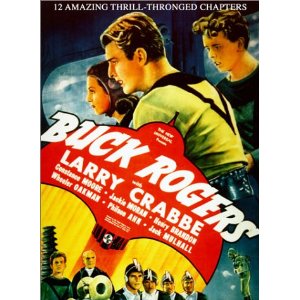 swashbuckler “Buck Rogers,” came courtesy of an aging character actor stuffed into a size-too-small spandex jumpsuit and a comedy-sidekick robot voiced by the late Mel Blanc.
Airing for three seasons from 1979-1981 on NBC, “Buck Rogers in the 25th Century,” was one of those late 1970s efforts by network execs to cash in on the cinematic excitement created by “Star Wars.”
But just like the fondly remembered “Battlestar Galactica” that preceded it, “Buck Rogers” was hobbled by weak writing, low production values, and the inevitable cheesetasticness of Gil Gerard as Buck sucking in his gut and breaking the fourth wall while making goo-goo eyes at the brave Wilma Deering (Erin Gray).
You used to be able to catch the 1970s “Buck” show on the syndication-dependent Sci-Fi Network before it became Scy-Fy and started reliably churning out starring vehicles for Debbie Gibson and poorly CGI-ed crocodiles and sharks.
So thank God for Turner Movie Classics, which has recently been screening the original 1939 Saturday morning serial starring the lantern-jawed Larry “Buster” Crabbe as Buck and Constance Moore as Wima Deering.
Alternately known as “Buck Rogers Conquers the Universe,” and “Buck Rogers: Destination Saturn,” may well be one of the stellar examples of the action serials that were a staple of film-going during Hollywod’s Golden Age.
“Star Wars” filmmaker George Lucas has admitted he took some of the inspiration for his own space opera from serials such as “Buck Rogers” and “Flash Gordon.”
Watching this iteration of the Buck Rogers serial (a 1950 TV show would precede the disco era “25th Century“), it’s not hard to trace some of Star Wars’ antecedents.
The 12-episode arc finds the dashing Rogers (Han Solo, anyone?) fighting along side a brave band of rebels to free the Earth of a tyrannic dictator named Killer Kane (he dresses in black and is uniformly evil. Guess who?).
In this effort, Rogers (Crabbe, who also portrayed Flash Gordon) is joined by the wise and aged Dr. Heuer, (Shaw) the plucky Wilma (Moore) and an idealistic, young sidekick named George “Buddy” Wade (Moran).
The band of freedom-fighters go through a series of adventures, including an incursion into Kane’s (Warde) palace (rhymes with “Death Star“) to rescue Prince Tallen (Ahn) so the rebels can forge an alliance with Saturn against Kane.
As was the case with many of the film serials of the time, Buck Rogers was based on a syndicated newspaper comic strip. Other comic heroes of the time — Superman, Batman, Captain America, Shazam and even the forgotten-except-by-fanboys Blackhawk — were also converted into grist for the unrelenting serial mill.
Viewed through the prism of 70 years, the special effects of “Buck Rogers” don’t seem particularly special to eyes used to movies made entirely on green screens.
The spaceships are clearly models and the deserts of California’s Red Rock Canyon State Park are enlisted as stand-ins for the futuristic Earth in which Buck and Buddy find themselves after spending 500 years in suspended animation.
Despite that, the action never lets up. Whether it’s Buck staging a daring escape from Killer Kane’s headquarters or fierce, one-on-one combat, audiences were rarely let up for air for the 30 brief minutes that Buck occupied their local Bijou’s screens each week.
That, of course, was the filmmakers’ intent — to leave audience gasping for more and wondering how Buck was going to escape from that week’s seemingly inescapable danger.
Though they took their cues from earlier adventure novels such as “The Three Musketeers,” and, later, pulps like “Black Mask,” the serials were a showcase for the uniquely American conceit that, no matter how inescapable the danger, or towering the obstacle, a little Yankee ingenuity and bravery would get you through.
That idea must have been inspiring for 1930s film audiences, who were yet to escape the doldrums of The Great Depression and were eyeing nervously a growing storm in Europe.
That’s a hopelessly quaint notion for the modern filmgoer. But in these complicated times, it would be nice if Hollywood delivered that kind of action flick again, without feeling the seemingly obligatory need for tossing a wink-and-a-nod in the audience’s direction as well.


 The Cineaste's Lament.
A friend of mine just emailed me one of your articles from a while back. I read that one a few more. Really enjoy your blog. Thanks