Here’s actress Elizabeth Olsen. She wasn’t pint-sized cute on “Full House.” And she’s not a multigajillionaire like her sisters. But what she is doing is building up some good buzz for her upcoming turn in “Martha Marcy May Marlene” directed by Sean Durkin.
“The 22 year old actress is on her way up, starring in five movie roles, all to hit the big screen in 2011 and 2012. She is currently enrolled at N.Y.U’s Tisch School of The Arts (my kind of girl!). You really have to honor and respect a young woman this age with this much spotlight, as it could sometime be overwhelming trying to grow up and earn a degree. My inspiration!”
In a fun video interview, actor Tom Hardy, who plays the villainous Bane in “The Dark Knight Rises,” talks about his role in the Christopher Nolan-helmed flick and what it’s like going up against Christian Bale. (via ComicBookMovie):
“A new film about Germany’s “chivalrous” Second World War commander, Erwin Rommel has provoked furious criticism from members of his family who claim that its authors portray the “Desert Fox” as an unscrupulous Nazi war criminal who was a favourite of Adolf Hitler.
Field Marshal Erwin Rommel (Picture from The Independent)
Defeated by General Bernard Law Montgomery’s 7th Armoured Division, the famed “Desert Rats”, at the decisive battle of El-Alamein in 1942, Field Marshal Rommel wrote that his campaign against the British was a chivalrous affair and the nearest thing to “war without hate”.
He was later alleged to have been involved in the July 1944 plot to assassinate Hitler. But he committed suicide after he was arrested by the Nazis and told that he would be put on trial for his offences and face certain death. In Germany and Britain he is still widely thought of as Nazi Germany’s “decent” general.”
The backlash against Netflix’s apparent corporate suicide continues. Talk about killing the goose that laid the golden egg.
The video rental service’s stock is down 38 percent from Sept. 15 through Tuesday, Bloomberg News reports this morning. That’s devastating.
Okay, so you have a Netflix account. You do the whole streaming thing AND the DVD thing (or BluRay if that's your flavor). And all is good. You watch a DVD, put it into that little red envelope and eagerly await your next red envelope to arrive. And in between DVD's, you stream thousands of shows to your TV. Ahhh, that's the life, isn't it? *Screach* "Not so fast there movie-buff. We need more money." About a year or so ago, Netflix raised … Read More
Here’s the text of an e-mail that Netflix co-founder and CEO Reed Hastings sent to subscribers this morning (Full disclosure: I subscribe to the streaming service):
Dear ….
I messed up. I owe you an explanation.
It is clear from the feedback over the past two months that many members felt we lacked respect and humility in the way we announced the separation of DVD and streaming and the price changes. That was certainly not our intent, and I offer my sincere apology. Let me explain what we are doing.
For the past five years, my greatest fear at Netflix has been that we wouldn’t make the leap from success in DVDs to success in streaming. Most companies that are great at something – like AOL dialup or Borders bookstores – do not become great at new things people want (streaming for us). So we moved quickly into streaming, but I should have personally given you a full explanation of why we are splitting the services and thereby increasing prices. It wouldn’t have changed the price increase, but it would have been the right thing to do.
So here is what we are doing and why.
Many members love our DVD service, as I do, because nearly every movie ever made is published on DVD. DVD is a great option for those who want the huge and comprehensive selection of movies.
I also love our streaming service because it is integrated into my TV, and I can watch anytime I want. The benefits of our streaming service are really quite different from the benefits of DVD by mail. We need to focus on rapid improvement as streaming technology and the market evolves, without maintaining compatibility with our DVD by mail service.
So we realized that streaming and DVD by mail are really becoming two different businesses, with very different cost structures, that need to be marketed differently, and we need to let each grow and operate independently.
It’s hard to write this after over 10 years of mailing DVDs with pride, but we think it is necessary: In a few weeks, we will rename our DVD by mail service to “Qwikster”. We chose the name Qwikster because it refers to quick delivery. We will keep the name “Netflix” for streaming.
Qwikster will be the same website and DVD service that everyone is used to. It is just a new name, and DVD members will go to qwikster.com to access their DVD queues and choose movies. One improvement we will make at launch is to add a video games upgrade option, similar to our upgrade option for Blu-ray, for those who want to rent Wii, PS3 and Xbox 360 games. Members have been asking for video games for many years, but now that DVD by mail has its own team, we are finally getting it done. Other improvements will follow. A negative of the renaming and separation is that the Qwikster.com and Netflix.com websites will not be integrated.
There are no pricing changes (we’re done with that!). If you subscribe to both services you will have two entries on your credit card statement, one for Qwikster and one for Netflix. The total will be the same as your current charges. We will let you know in a few weeks when the Qwikster.com website is up and ready.
For me the Netflix red envelope has always been a source of joy. The new envelope is still that lovely red, but now it will have a Qwikster logo. I know that logo will grow on me over time, but still, it is hard. I imagine it will be similar for many of you.
I want to acknowledge and thank you for sticking with us, and to apologize again to those members, both current and former, who felt we treated them thoughtlessly.
Both the Qwikster and Netflix teams will work hard to regain your trust. We know it will not be overnight. Actions speak louder than words. But words help people to understand actions.
Respectfully yours,
Reed Hastings, Co-Founder and CEO, Netflix
p.s. I have a slightly longer explanation along with a video posted on our blog, where you can also post comments.
A 3-D Reissue Of A 15-Year-Old Movie …
… ruled the box office this weekend. Proving that the Circle of Life — or at least Disney’s marketing machine — is still in effect, the “Lion King” roared big in theaters. Here’s the weekend by the numbers.
Name: Weekend: Total:
1. The Lion King (in 3D) $29.3m $29,3m
2. Contagion $14.5m $44.1m
3. Drive $11m $11m
4. The Help $6.4m $147m
5. Straw Dogs (2011) $5m $5m
6. I Don’t Know How She Does It $4.5m $4.5m
7. The Debt $2.9m $26.5m
8. Warrior $2.7m $9.9m
9. Planet of the Apes $2.6m $171m
10. Colombiana $2.3m $33.3m
The Observer takes a look at our ongoing love affair with romantic-comedies and the remarkable durability of the genre, which is now eligible for Social Security and, quite possibly, a monument on The National Mall.
As always, here’s the nut graf:
“Romantic comedies seem to take over where the fairytales of childhood left off, feeding our dreams of a soulmate; though sadly the Hollywood endings prove quite elusive in the real world. For many of my generation, Woody Allen’s Annie Hall was our introduction to onscreen dating and came as a great relief after the celluloid bloodbath prompted by Vietnam. Lines like “That sex was the most fun I’ve ever had without laughing” provided perfect tittering material for 15-year-old schoolgirls in Ireland – though we couldn’t understand why a cool woman like Annie would waste time on a geek like Woody Allen. After all, Les McKeown of the Bay City Rollers and David Cassidy were yet to be snapped up! A decade or so later the Nora Ephron-scriptedWhen Harry Met Sally captured another zeitgeist moment when the romantic rogues so attractive in our teens began to lose their allure, and finding Mr Right instead of Mr One Night became an ambition. A few cataclysmic years later, Four Weddings and a Funeral summed up our emotional biosphere again, cowering in the shadow of the Aids epidemic and miserably attending the seemingly endless nuptials of the lucky few while desperately trying to keep the party going. And so it went on with poor old Meg Ryan breathing life into more Ephron scripts as we witnessed her bumpy dating experiences in real life.”
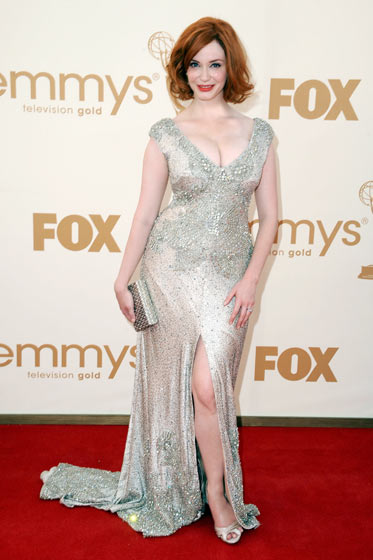
And in a gratuitous exercise in search-engine optimization, here’s the dress that Christina Hendricks was wearing at The Emmys last night:
Christina Hendricks on the Emmy Red Carpet Last Night.
Writers: S.S. Van Dine (book); Lenore J. Coffee (screen adaptation)
Directors: David Burton, Nick Grinde
Cast:
Basil Rathbone: Philo Vance
Leila Hyams: Belle Dillard
Roland Young: Sigurd ‘Erik’ Arnesson
Alec B. Francis: Professor Bertrand Dillard
George F. Marion: Adolph Drukker
Zelda Sears: Mrs. Otto Drukker
Bodil Rosing: Grete Menzel
Carroll Nye: John E. Sprigg
Charles Quatermaine: John Pardee
James Donlan: Sergeant Ernest Heath
Sidney Bracey: Pyne, Dillard’s Butler
Clarence Geldart: John F.X. Markham
Delmer Daves: Raymond Sperling
Nellie Bly Baker: Beedle, the Maid
Run-Time: 88 mins.
Studio: Metro-Goldwyn-Mayer
This early talkie adaptation of a novel by mystery writer S.S. Van Dyne’s fictional sleuth Philo Vance is notable for a couple of reasons.
For openers, it marked the first time that the Johannesburg-born Rathbone would inhabit the on-screen personification of a fictional detective. From 1939 to 1951, the hawk-nosed actor would make some 16 film and TV appearances as Sir Arthur Conan Doyle’s most famous creation — Sherlock Holmes.
It’s hard to believe now, but there was a time when Van Dyne’s “Philo Vance” was as important a fictional creation as Raymond Chandler’sPhillip Marlowe and Dashiell Hammett’sSam Spade. A quick inspection of Amazon reveals that Vance’s adventures are easily available as e-books, but hardcover editions of the 1920s-vintage gumshoe are fetching a hefty price.
The “Bishop Murder Case” opens with Vance called in by D.A. F.X. Markham (Geldart) to investigate the death of a wealthy man, Joseph Cochrane Robin, nicknamed “Cock Robin” who’s been found dead with an arrow through his heart. A note sent along with the murder is signed “The Bishop” and references to nursery rhymes abound. A series of murders follows, each accompanied by the Bishop piece from chess and another nursery rhyme. As the clock run downs, it’s up to Vance to piece together the mystery.
And here’s where we get to the other reason that “The Bishop Murder Case” stands out. It’s not for the performances, some of which are painfully wooden. James Donlan, as police Sgt. Ernest Heath, turns in a pulp-novel stereotype of a beat cop.
The performances notwithstanding, “The Bishop Murder Case,” is a terrific example of the early, stagey examples of filmmaking, when movies felt more like plays that were captured on film than as works of art with their own unique vocabulary of camerashots, cutaways and techniques. There is a reason, after all, that credits are given for both film and stage direction in the movie.
Scenes shot in a professor’s study and around the dinner table just seem to be missing the curtain to come down to mark the end of each act. And there’s the significant over-emoting necessary to reach the cheap seats in the back of the theater and the balcony.
But watching vintage mysteries such as “The Bishop Murder Case,” and later 1940s and 1950s noirs almost makes you wish it were still obligatory for directors to film their mysteries in black-and-white. The shadows cast by the old BW films contribute much to the mood of these films that can’t be captured when they’re shot in color.
This one’s a necessary artifact for any serious student of the detective genre on film. Again, not for the performances and plotting, but what the tone it sets for the works to come.
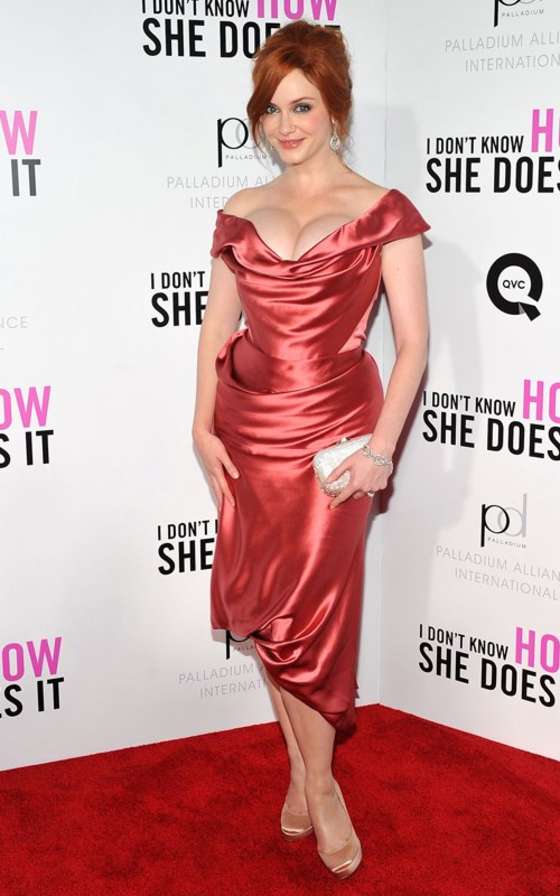
Writing in The Guardian today, Hadley Freeman has a great interview with “Mad Men” actress Christina Hendricks, who’s starring in this
Christina Hendricks at the premiere of "I Don't Know How She Does It."
month’s “I Don’t Know How She Does It” with Sarah Jessica Parker and the upcoming “Drive” with RyanGosling.
Freeman meets up with Hendricks in Los Angeles, finding her a throwback to classic Hollywood glamour.
As always, here’s the nut graf:
“Even without the 60s pencil skirts and beehive do that her character, Joan Holloway, currently models in Mad Men, Hendricks, 36, looks like something from a different age who has somehow landed in the modern day. This is not, I should add, a veiled reference to her frankly over-discussed figure. Since Mad Men began in 2007, some critics have been so busy noting how we live in an era so different from the sexist workplace of Sterling Cooper – in which women’s bodies are lustily discussed in front of them – that they have apparently not noticed they often do the same thing with actors, especially Hendricks. It’s hard to think of another female star whose body has come under so much scrutiny of late. While most of the attention has been positive, there is a thin line between celebrating someone’s appearance and reducing that person to nothing more than her physique. And this would be unfair to Hendricks because her performance as Joan is very subtle, lifting the character beyond camp and vamp.
And anyway, Hendricks’ retro quality is not simply due to her womanly shape. It’s also down to her ramrod deportment – probably a hangover from her teenage years spent doing ballet – and her voice, which is more Marilyn Monroe-ishly girlish than it is as Joan, rising to high-pitched babyish when she talks about Arend (“I am kinda crazy about him,” she concedes, when she catches herself smiling when his name flashes up on her phone). Her walk is pure Joan sashay.
“‘Yeah, my husband says, ‘What Joan walk? You’ve always walked that way!” She laughs.”

 multigajillionaire like her sisters. But what she is doing is building up some good buzz for her upcoming turn in “Martha Marcy May Marlene” directed by Sean Durkin.



 The Cineaste's Lament.