Flashbacks Of A Fool (UK, 2008)

Title: Flashbacks of a Fool
Release Date: 2008
Director: Baillie Walsh
Writer: Baillie Walsh

Cast:
Daniel Craig: Adult Joe Scot
Julie Ordon: Carrie Ann
Gina Athans: Apple
Eve: Ophelia Franklin
Olivia Williams: Grace Scot
Jodhi May : Evelyn Adams
Keeley Hawes: Adult Jesse Scot
Claire Forlani: Adult Ruth

Run-Time: 110 mins.
Studio: Left Turn Films

So here’s the movie for those of you officially in the throes of a mid-life crisis and wondering where the hell it all went so wrong.

This British import had been popping up quite a bit on cable this summer. And since it starred the steely-eyed newest incarnation of James Bond, I decided to give it a whirl.

Having seen Daniel Craig in only one other role, as the lead in the British caper flick “Layer Cake,” I wasn’t sure what to expect from “Flashbacks of a Fool,” though the title seemed promising.

Here, Craig plays Joe Scot, a fading
and dissolute actor (is there any other kind in situations like this?) who’s just about run out of chances in Hollywood.

As the film opens, Joe’s just come off a night-long dalliance with two lovelies, and in his ravaged and hung-over state, he’s ministered to by his assistant, Ophelia Franklin, played by the rapper Eve in an understated and strong performance.

The action really begins, however, when Joe learns of the death of his childhood best friend, Boots, and has to return home to England for a funeral.

The movie then switches into a protracted flashback sequence, taking the viewer — and Joe — back to his teenaged years in a seaside English town.

In the seaside England of his imaginings, Joe’s world is cast in the pale light of a faded postcard, all gauzy and diffuse, just the sort of way you remember the endless and languid beach afternoons of your youth, when your eyes sting from suntan oil and sweat and you have that deep, good tired that means you’ll sleep soundly through the night.

Would that it was as easy to develop such affection for young Joe, who, it must be said, is something of self-absorbed ass, foreshadowing the self-absorbed ass he is destined to become as an adult.

Boots, the faithful friend, is painfully abandoned during one scene for a young glam girl named Ruth (Felicity Jones), though this scene of abandonment leads to one of the more touching sequences of the film.

If you were English and loved pop music in the middle-1970s, the chances were pretty good that you followed the glam-rock scene led by David Bowie and Mark Bolan.

Bowie and Bolan’s guitar-drenched songs, with their lyrics and look steeped in androgyny, were an antidote to the heavy, hippy rock that had preceded it.

So it’s no surprise to see Joe and young Ruth slapping on make-up and miming to a Bowie record. Nonetheless, it’s still a touching reminder of the effect the right girl can have at you when she comes along at the right time, and how much that effect is amplified if you’re a romantically inclined teenager.

Making things difficult, however, is the fact that Joe is also conducting a furtive relationship with a neighbor, Evelyn (Jodhi May), and his guilt over his duplicity prompts him to leave home.

The film shifts back to present-day, where we find Joe making an uneasy peace with the adult Ruth (Claire Forlani), who grew up to marry Boots, and is now a widower with a child.

It may have been because of the lateness of the hour with which I viewed it, but I found the film a bit difficult to follow. The fact that the dialogue also appeared to have been recorded at a level best suited for dogs was also a deterrent to enjoying the movie.

That said, there was enough conveyed in the body language of the young characters that the tentativeness and uncertainty of youth came through. And the pain in the adult Joe’s eyes was a convincing enough reminder of the profound effect the experiences of youth can have in shaping us as adults.
Posted in drama, Our Films, Ourselves | Leave a comment

The March Of Time (USA, 1935-67)

Title: The March of Time
Release Date: 1935-1967
Writers: Richard and Louis de Rochemont
Created By: Roy Edward Larsen
Run-Time: 30 mins.

When I was kid growing up in Connecticut, our local PBS station used to run a show called “Matinee at the Bijou,” which was intended to be an accurate reproduction of what it was like to go to the movies on a Saturday afternoon in the 1940s.

The show took up most of a Saturday afternoon, including as it did, a cartoon, a newsreel, a serial and then a feature that ran 90 or so minutes.

It was a great way, as a 10- or 11-year-old kid, to be introduced to the wonders of moviegoing. And it was an even better way to bond with my Mom, a child of the 1940s, who attended those Saturday matinees in theaters in Hartford, Conn., when she was a little girl.

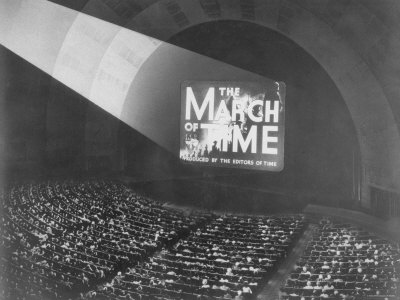
The March of Time” is pretty typical of newsreels of the era, so much so, in fact, that Orson Welles even saw fit to parody it in “Citizen Kane” in 1941.

Produced by publishing giant Time Inc. as a way to promote its print product, “The March of Time” ran in monthly installments for 16 years, totaling about 200 episodes.

On Memorial Day this year, Turner Movie Classics ran a mini-marathon of the 30-minute newsreels, and what emerges (after protracted viewing) is a kind of “60 Minutes” of its day.

The DNA of what we’ve come to know as the modern news magazine show is all here: dramatizations, stentorian voice-overs, and a tendency toward the sensational.

One of the episodes I watched, from November 1943, focused on the toll that extended overseas deployments were taking on the children of American servicemen and women.

With little more than assertion to back up its findings, Time’s faceless narrator concluded that young men were running wild — disobeying their parents and sneaking joints in dark corners with their friends.

Young women fared little better — the newsreel depicts them (what else?) turning into brazen hussies patriotically throwing themselves into the arms of sailors home on shore leave.

Another newsreel, focusing on life behind enemy lines in Nazi Germany, provides a fascinating look at the highly regimented and strictly controlled German culture at the middle of the 20th century.

While the newsreel offers some condemnation of Hitler’s government, an unsettling thread of what feels like admiration also runs through it. But footage of a German-American bund sympathetic to the Nazi junta is particularly unsettling.

In an age before TV, when radio and newspapers still reigned supreme, it’s important to remember that these newsreels were the way that many Americans stayed informed during the 1930s and 1940s.

You can view some of the newsreels here (registration required).

And here’s the show-reel from YouTube:

Posted in Golden Age of Cinema, Matinee at the Bijou, Newsreels, Our Films, Ourselves | Leave a comment

Weekend At Bernie’s (USA, 1989)

Title: Weekend at Bernie’s
Release Date: 1989
Director: Ted Kotcheff

Cast:
Andrew McCarthy: Larry Wilson
Jonathan Silverman: Richard Parker
Catherine Mary Stewart: Gwen Saunders
Terry Kiser: Bernie Lomax
Don Calfa: Paulie, Vito’s Hit Man
Catherine Parks: Tina, Vito’s Girl
Eloise DeJoria: Tawny
Gregory Salata: Marty, Vito’s Assistant
Louis Giambalvo: Vito

Run-Time: 97 mins.
Studio: Gladden Entertainment

Let us now pause for a moment to praise the greatness of … corpse desecration jokes.

Because, when you get right down to it, this late 1980s farce-comedy starring Andrew McCarthy and Jonathan Silverman isn’t so much a movie as it is an effort to find new ways to subject a mannequin to a series of increasingly inventive humiliations to reach its 97-minute running time.

And that really isn’t so much a knock as an explanation. It is, really, its genius. Because “Weekend at Bernie’s” may well be the example, par excellence, of that much-maligned sub-genre that, for a lack of better term, we’re going to call “Guy Cinema.”

The fellas reading this post know what I’m talking about. They’re the Farelly Brothers flicks. Or “Airplane,” or “The Three Stooges” — in essence, any movie where your girlfriend/wife/sister/mother/aunt gets up and leaves the room with a disgusted shake of their head, leaving you and your buddies to howl like baboons for an hour-and-a-half at the increasingly stupid onscreen hijinks.

In 20 years of watching this movie, I’ve never had a member of the fairer sex make it to the end credits. In fact, when I told my amazingly patient wife that I’d be writing about this movie for “The Cineaste’s Lament,” she looked at me with something between pity and revulsion, and said, “You’re on your own,” and then went off to knit.

So there I was, alone in the living room, somewhere around midnight, laughing, as I always do, when the title character’s body goes caroming off a buoy somewhere in Long Island Sound.

The plot of “Weekend at Bernie’s” barely matters, but we’ll sum it up anyway: Two working stiffs, Larry and Richard, (McCarthy and Silverman) discover that someone at the NYC insurance company where they toil is embezzling. They present their findings to their boss, Bernie Lomax (Kiser), who then invites the pair out to his beach house on Long Island to investigate further.

Little do they suspect of course, that Bernie is doing the embezzling on behalf of the mob. But the mob’s had enough of Bernie, not least because he’s had to lack of foresight to sleep with gangster Vito Giambalvo’s moll. The mob whacks Bernie instead. Larry and Richard discover that Bernie intended to pin the embezzling on them. So they decide to pretend that he’s alive to keep the mob from killing them.

From there, it’s a race against time — and decomposition — as our heroes try to escape from the island where they’re supposed to be holidaying.

There’s a subplot featuring Richard’s fumbling efforts to woo a summer intern, played by Catherine Mary Stewart, who, for reasons that we suspect had to do with union rules, seemed to feature as the love interest in just about every comedy of the period. And the slob/mensch dynamic between McCarthy’s and Silverman’s characters makes for a nice comedic contrast.

Kiser picks up what may have been the easiest pay-day in the history of American cinema, since, for 90 minutes, he’s required to do little else but wear sunglasses and a wry grin and put up with sight gags that find him (or his rubber dummy) repeatedly buried, soaked, dragged or dropped from greater or lesser heights.

Improbably, the movie even birthed a sequel that saw Kiser’s corpse reanimated as a zombie. Naturally, it had none of its predecessors admittedly juvenile charms — though that didn’t stop me from staying up late one night to watch it on cable.

So, fellas, the next time this one comes on cable, call your friends, banish your significant others from the room and pause, once again, to praise the greatness that is the Guy Film.

Posted in comedy, Guy Cinema, slapstick | Leave a comment

How To Lose Friends and Alienate People (UK, 2008)

Title: How To Lose Friends and Alienate People
Release Date: 2008
Director: Robert B. Weide
Writers: Toby Young (book), Peter Straughan (screenplay)

Cast:
Simon Pegg: Sidney Young
Megan Fox: Sophie Maes
Gillian Anderson: Eleanor Johnson
Jeff Bridges: Clayton Harding
Kirsten Dunst: Alison Olsen

Run-Time: 110 mins.
Studio: Number 9 Films

There’s a number of questions that you can ask yourself about “How to Lose Friends and Alienate People.”

Here’s just a few that rush immediately to mind: Does the world really need yet another roman a clef about life at a magazine in the vast Conde Nast media empire (see “The Devil Wears Prada” and “Bright Lights, Big City.”)? Has a movie yet been made that tests Megan Fox’s gifts as an actress? Does the presence of Jeff Bridges in a film lift its classiness by an order of magnitude? And why is Kirsten Dunst, who brings a lemondade-y beauty to every role, so criminally underused as an actress?

The answers, as near as I can figure are these: 1. Yes, sorta. 2. Not so far. 3. Absolutely. 4. I have no idea.

To be sure, there’s nothing new under the sun about the plot of this film: Young buck comes to the big city hoping to make his mark. After initial flailing attempts, he makes it to the inside, only realizing that it little profits a man if he gains the whole world only to lose his soul, and redemption comes from the beautiful girl who was there under his nose the whole time. Music swells. End credits. Fade to black.

In this version, Pegg plays British journalist Sidney Young, a brash ne’er do well who edits a rag called “Postmodern Weekly.” After making something of a splash, he’s snatched up and spirited away to America to work for “Sharps” magazine, a glossy monthly edited by Clayton Harding (Bridges), who sees echoes of his younger self in Sidney.

This is where the roman a clef bit comes in: Pegg’s character is the fictional doppelganger of actual British journalist Toby Young, whose disastrous tenture as a reporter for real-life glossy Vanity Fair, memorialized in a book of the same name, serves as the source material for the film.

Pegg, a gifted comedic actor, brings the same affable cluelessness he brought to earlier roles (“Shaun of the Dead,” “Hot Fuzz“). In his hands, Toby strives to be an iconoclastic and hard-charging journalist in the mold of Hunter S. Thompson in a magazine filled with fawning show-ponies. His utter failure to fit in only makes his efforts that much more touching — and hilarious.

Avid media-watchers will also recognize Bridges as the fictional doppelganger of real-life Vanity Fair editor Graydon Carter, a Canadian who made his name in the 1980s as the editor of the bitingly satirical (and sadly departed) Spy magazine.

“How to Lose Friends,” functions best when it ignores the rom-com subplot between Pegg’s character and a Sharps sub-editor named Alison Olsen (Dunst) and sticks with the meta-commentary about the celebrity-industrial complex and the legions of magazines that perpetuate its myth.

The look of disgust that crosses Sidney’s face when a power-publicist (Anderson) that she’ll need photo and copy approval is just classic — and ought to resonate with any reporter who’s ever had to explain the basic precepts of the First Amendment to a source. At this early stage, he imagines himself above the sycophantic profiles that are the stock-in-trade of celebrity rags. Of course, we know, it’s inevitable he’ll sell out by the tail-end of the films’s second act.

Fox, who remains as wet-lipped and stunning as ever, essentially plays herself as Sophie Maes.

She’s a well, a wet-lipped and stunning aspiring actress of dubious gifts, built-up by the very same celeb-industrial complex, so that her inept starring role in a biopic of Mother Teresa — of all people — lands her what appears to be a Golden Globe nomination for best actress. The fictional trailer for the fictional film is laugh-out-loud funny in its purposeful awfulness.

Seeing Fox in this role now, with the baggage attached to her real-life career, makes one wonder if she’ll ever be handed a part that does not involve her playing the obligatory hottie who’s either running from giant robots or toying with men’s hearts. As Sophie Maes, she’s not particularly required to stretch herself as an actress.

Bridges brings curmudgeonly humor to his role as Sharps’ editor-in-chief. Sporting extensions that mirror Graydon Carter’s own leonine mane, he steals just about every scene he’s in, including a hilarious segement where he admonishes Toby, fresh off a disastrous interview with a Broadway star, to never ask musical-theater actors if they’re Jewish or gay.

“Just assume they’re Jewish and gay,” he grumbles, and it’s hard not to mistake the glee he brings to the role.

Dunst isn’t given nearly enough to do as the sub-editor who serves as Toby’s initially reluctant guide through the halls of the magazine. But you just know they’ll be in love by the end of the film. And, sure enough, they are. Someone really needs to develop a starring vehicle for her.

Little-noticed when it was first released, “How To Lose Friends” ought to be required viewing in introductory journalism classes. For all its pretensions toward romantic-comedy, it’s actually a pretty insightful bit of media criticism that seems even more necessary when Jon & Kate” are hotter Twitter trending subjects than “Collapsing Economy” or “War in Afghanistan.”

Posted in comedy, Our Films, rom-com, roman a clef | Leave a comment

Another Fine Mess (USA, 1930)

Title: Another Fine Mess
Release Date: 1930
Director: James Parrott
Writer: H.M. Walker

Cast:
Stan Laurel: Stan
Oliver Hardy: Ollie
Thelma Todd: Lady Plumtree
James Finlayson: Colonel Wilburforce Buckshot
Charles K. Gerrard: Lord Leopold Ambrose Plumtree

Run-Time: 30 mins.
Studio:Hal Roach Studio

And here’s how an immortal American catch-phrase was born.

The chances are pretty good you’ve caught yourself, when something goes wrong, putting on a vaguely twittish English accent, turning to your companion and saying, “Well, here’s another fine mess you’ve gotten me into.”

And if you thought about it, the chances are equally good that, somewhere in the depths of your subconscious, you know that snippet of dialogue was uttered by one half of American cinema’s most enduring comedy teams: Stan Laurel and Oliver Hardy.

But do you know which member of this classic slapstick team really uttered those words? If you’re putting on the vaguely twittish English accent, then you’re channeling the spirit of the late Oliver Hardy (the heavy one).

The only problem is, you’re wrong. Hardy never said it.

Sort of.

He did often say, however, “Here’s another nice mess you’ve gotten me into,” and the phrase traces its origins to the “Laurel & Hardy Murder Case” also released in 1930.

Hardy uttered it again in “Another Fine Mess,” and it’s thought that the misquote owes its origin to the title of the 30-minute short, one of several, the duo made for Hal Roach’s studio.

But don’t let that get in the way of your enjoyment of this masterful work of film-making in miniature.

Almost all the signposts of what we’ve come to associate with slapstick comedy are here: two lovable losers trying to pass themselves off as someone they’re not; cross-dressing; upper-class twits and a more than healthy amount of cartoonish violence that would be utterly unsurvivable were it to happen in the real world.

This one opens with Stan and Ollie, here portraying a couple of vagabonds, on the run from the police. They stumble into the mansion of Col. Buckshot, who’s on safari in Africa. Things quickly go from bad to utterly surreal.

Once again, I won’t give away the ending here. Suffice to say, the resolution is about as absurd as you’ve come to expect from a Laurel & Hardy short.

After a couple of nights in a row of features, this one was a nice palate cleanser — kind of like listening to a Clash song after a steady diet of Emerson, Lake and Palmer.

Watching this short — which I first saw years ago and never really appreciated for its place in the comedic firmament — was a reminder of how little (even after eight decades) the conventions of movie comedy have changed.

Sure, the jokes may have gotten a little more blue, or a little more focused on bodily functions, but, in the final analysis, everyone from Judd Apatow to Adam Sandler and Steve Martin owes a clear debt to the buffoonish trail blazed by Stan Laurel and Oliver Hardy.

Martin’s “Navin Johnson” of “The Jerk” wouldn’t have existed without them. Ditto for any of the kind-hearted morons that Sandler portrayed in his early films.

And despite their predilection for drag, the fellas in Monty Python weren’t the first guys to put on a dress to get a laugh.

If you’re looking for the DNA of film comedy, you find it, in its purest form, in the shorts of Stan Laurel and Oliver Hardy.

And they’re as funny as ever.

Posted in comedy, Golden Age of Cinema, slapstick | Leave a comment

Confidential Agent (1945, USA)

Title: Confidential Agent
Release Date: 1945
Director: Herman Shumlin
Writers: Graham Greene (novel); Robert Buckner (screenplay)

Cast:
Charles Boyer: Luis Denard
Lauren Bacall: Rose Cullen
Victor Francen: Licata
Wanda Hendrix: Else
George Coulouris: Captain Currie
Peter Lorre: Contreras
Katina Paxinou: Mrs. Melandez
John Warburton: Neil Forbes
Holmes Herbert: Lord Benditch
Dan Seymour: Mr. Muckerji

Studio: Warner Bros.
Run-Time: 2 hours

So here’s a movie that historical amnesiacs and social-realists can both adore.

Based on a Graham Greene novel of the same name (“The Confidential Agent” — why Warners chose to drop the definite article is something of a mystery) is an odd film that sits somewhere between romance, thriller and war movie.

Confidential Agent” tracks the adventures of Luis Denard (Boyer), a former musician, now fighting on the loyalist side in the Spanish Civil War, who’s been sent to England to secure a shipment of coal that apparently means the difference between success and defeat at the hands of the fascist Republicans.

Released by Warner Bros in the waning days of World War II, the film carries an implicitly anti-fascist message — there’s no doubt about who the bad guys are in this one. With the Spanish Civil War barely seven years in the past, contemporary audiences had to know the Republican side had the backing of Nazi Germany and Mussolini’s Italy. At all times, Boyer’s Denard is made to look like he’s fighting a noble — if ultimately doomed — struggle against an incipient military dictatorship.

But this being 1945, the movie is oddly silent on the fact that Denard, a loyalist, was, like most fighting to restore the Second Spanish Republic, a Socialist. At the time, the regime had the backing of Stalin’s Russia and the Civil War was seen, largely, as a proxy conflict between Russia and Germany. It was, in any event, a dress rehearsal for World War II.

The politics being a touch on the muddy side (it’s never explicitly stated that the “D” of Greene’s novel is a Loyalist, but you’d have to have been pretty thick not to make the connection), the “Confidential Agent” mutates after its first act into classic piece of noir, with the shadows and fog of London. The darkish mood is abetted by the fact that the action seems to take place almost exclusively at night.

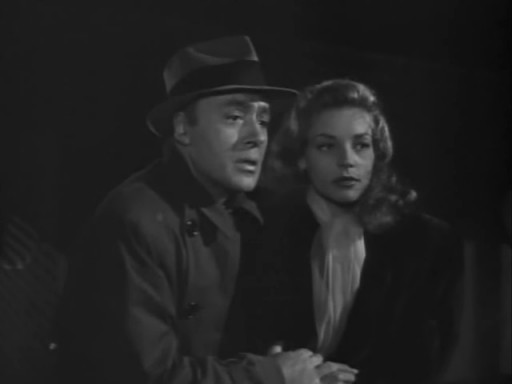
This being a noir, there has to be a tough girl — and this role is more than ably filled by Rose Cullen (Bacall), an American expatriate living in England. As the film opens, we find her in the 3rd Class bar of a tramp steamer, where’s she sharing the same Channel crossing as Denard. There’s a classic moment where Rose unflinchingly orders the barman to snag her Scotch from the first-class lounge because its better there. This comes just seconds after she’s spurned the advances of a stereotypically snaggle-toothed English twit.

Upon making landfall, things get a little fuzzy. Denard finds his mission for more coal spurned, and also finds himself being chased by Republicans who try to thwart his mission by framing him for the murder of a young chambermaid. These matters are eventually unraveled, but I won’t give away how that happens.

The film is marred by an over-long third act, whose centerpiece is a long soliloquy by Denard on how work may be noble — but its products (in this case, coal) — should never be used for an evil end. A sympathetic reception from a crowd of miners turns ugly and he soon finds himself being pelted with stones.

And just when it seems Denard is a goner, he gets an unlikely assist and is smuggled out of the country. Again, I’ll leave it that. The film is airing on Turner Classic Movies this month, so it should be pretty easy to track down.

Watching the film, I couldn’t help but be reminded of the ambiguities of American foreign policy in the second half of the last century. FDR’s government largely stayed out of the Spanish conflict — even as hundreds of American volunteers rushed to serve on the Loyalist side. Meanwhile, the nation’s industrial sector made a pretty profit equipping the Republicans (not the last time the interests of the industrial sector would be put above those trapped in the crossfire of war).

Posted in action, Golden Age of Cinema, Noir | Leave a comment

The Hunt For Red October (1990, USA)

Title: The Hunt For Red October

Release Date: 1990
Director: John McTiernan
Writers: Tom Clancy (novel); Larry Ferguson and Donald Stewart (screenplay)

Cast:
Sean Connery: Marko Ramius
Alec Baldwin: Jack Ryan
Scott Glenn : Bart Mancuso
Sam Neill: Captain Borodin
James Earl Jones: Admiral Greer
Joss Ackland: Andrei Lysenko
Richard Jordan: Jeffrey Pelt
Peter Firth: Ivan Putin
Tim Curry: Dr. Petrov
Courtney B. Vance: Seaman Jones
Stellan Skarsgård: Captain Tupolev
Jeffrey Jones: Skip Tyler
Fred Dalton Thompson: Admiral Painter

Studio: Paramount
Run-Time: 2hr. 15 mins.

In almost every way that matters, watching the filmed version of potboiler-machine Tom Clancy’s debut novel is like unearthing a time capsule.

In the world of “Hunt for Red October,” the concept of American Exceptionalism wasn’t just an idea taught in high school history classes, it was a living breathing entity.

In 1990, the year this film was released, the Berlin Wall had fallen, Communism was crumbling across eastern Europe and the once fearsome Soviet Union was about to become the Boris Yeltsin-led Russian Federation, which would the next decade plus as our drunken, noisome cousin, who we worried more would barf on the furniture and leave its underwear on the door than shower fiery nuclear death upon an unsuspecting populace.

Directed by John McTiernan — whose past credits include the first, two movies of the seemingly unkillable “Die Hard” franchise, and, later, a remake of the “Thomas Crown Affair,” that, while not without its charms, failed to live up to the virtues of the Steve McQueen original — “Red October” belongs to a bygone age when Hollywood still made action films for grown-ups and smart people.

It didn’t take a degree in engineering and a nuanced understanding of international relations to understand the plot: Famed Russian Navy captain (Connery) steals cool, new sub that can run quietly and park a warhead in Times Square before anyone can shout “Borscht!.” Smart American CIA operative (last time that would be believable, too) played by Baldwin figures out what’s happening and tries to help him. The Russians, meanwhile (embodied by Skarsgard) try to stop him. Viewers on edge of seat for 175 minutes until the whole kit-and-kaboodle is resolved.

On the surface, it’s the standard chase flick, slapped with a coat of already peeling Cold War-era paint and shot through with some absolutely preposterous accents from the Russian sub crew (Connery, for instance sounds like a more walrus-y Connery, even if his character is Lithuanian).

What sets “Red October” apart from its cheeseball action-flick brethren, however, is its relentless focus on plot and characterization.

For the better part of two hours, there’s nary a wasted moment or useless gesture. The film sucks you in from its opening moments and keeps you there. For that, you can jointly thank screenwriters Ferguson and Stewart, along with Clancy, who may have later turned into a hack, but who, in his early novels was a master of the political thriller, where pacing is all.

McTiernan also assembled quite possibly one of the best casts in filmdom. At all points, the men of the film — and they’re all men, there’s nary a distaff character in sight — becoming a kind of fin-de-ciecle version of the “Magnificent Seven,” if the Seven spent all their time on naval vessels.

Baldwin, then still making his bid for matinee-idoldom, turns in an understated and sympathetic performance as Jack Ryan, the bookish CIA analyst-turned-reluctant hero.

The already larger-than-life Connery dominates every scene he’s in as the rebellious sub captain Marko Ramius, making what could have been easily become a caricature of character into one instantly relatable — he’s rebelling from grief over his dead wife.

But as is the case with all great stories, the amazing cast of supporting players lend the film a weight and heft it would not have otherwise had. Courtney B. Vance as the brainy sonarman Seaman Jones is indispensable, ditto for James Earl Jones as Ryan’s mentor, Admiral James Greer. Scott Glenn’s turn as American sub commander Bart Mancuso combines just the right amount of frontier swagger with the quiet confidence of a career officer, and who can forget Fred Thompson’s brief appearance as a Navy admiral (“The Russians don’t take a dump without a plan, son.“)?

All this happens because McTiernan was one of the last American directors to helm an actioner that didn’t allow the special effects and CGI to take precedence over character. The model submarines lumber convincingly through the murky depths of the North Atlantic, even when they’re being chased by clearly CGI’d torpedoes.

The transition to the brainless action flick came six years later with Roland Emmerich’sIndependence Day,” which marked the first time that human actors started taking a back-seat to the special effects. The trend has reached its apogee with the “Transformers” franchise. I may know that Shia LaBoeuf and Megan Fox star in the opening installments, but no one has convinced me that I should care about them.

Contrast that with the closing moments of “October,” where Baldwin and Connery share a quiet moment on the bridge of the captured Russian sub as it steams along some rural river in Maine:

“‘And the sea will grant each man new hope, as sleep brings dreams of home’ — Christopher Columbus,” Connery’s Ramius says.

“Welcome to the New World, Captain,” Baldwin’s Ryan returns, providing a stark reminder that you’d have to look long and hard to find historical allusions in most contemporary action films — even the ones that don’t purposefully set out to insult your intelligence.

Posted in action, Alec Baldwin, Ourselves, Sean Connery, thriller | Leave a comment

Whip It (2009, USA)

Title: Whip It
Release Date: October 2009
Director: Drew Barrymore
Writer: Shauna Cross

Cast:
Ellen Page: Bliss Cavendar
Marcia Gay Harden: Brooke Cavendar
Kristen Wiig: Maggie Mayhem
Drew Barrymore: Smashley Simpson
Juliette Lewis: Iron Maven
Jimmy Fallon: ‘Hot Tub’ Johnny Rocket
Alia Shawkat: Pash
Eve: Rosa Sparks
Zoe Bell: Bloody Holly
Ari Graynor: Eva Destruction
Eulala Scheel: Shania Cavendar
Daniel Stern: Earl Cavendar
Studio: Mandate Pictures
Run-Time: 111 minutes

Based on a novel (“Derby Girl“) by real-life roller derby athlete Shauna Cross, Drew Barrymore’s directorial debut is a warm, funny film that reflects its creators most charming traits.

The story focuses on Bliss Cavendar (Page), a girl from small-town Bodeen, Texas (Michigan stands in for the Lone Star State in the film), who’s been groomed, seemingly since birth, to reach the heights of beauty pageant success that eluded her mother, Brooke (Gay Harden).

A postal worker, Brooke is the domineering stage mother, par excellence, who’s badgered her daughter down a path she doesn’t want to follow. In this case, it’s winning the hallowed “Miss Blue Bonnet” competition.

In fairly short order, Bliss, and best friend Pash (Shawkat), meet up with members of The Hurl Scouts, an all-girls roller derby team who compete in nearby Austin. Bliss becomes entranced by the elaborately tattooed tough girls, and before long, she’s a member of the Hurl Scouts (who dress in torn Girl Scout uniforms) and competing in the TXRD (Texas Roller Derby) League.

Of course, the team are utterly hapless when Bliss arrives and utterly resistant to their coach, Razor’s (Andrew Wilson) efforts to teach them the elaborately constructed plays he keeps in a red-bound notebook.

From there, the film veers into “Bend it Like Beckham” territory, as Bliss lies to her parents about her whereabouts (she’s at an SAT class, and not practicing with the team, honest!); exhibits a talent and love for roller derby (the film takes its name from a signature roller derby move, the whip, where a player grabs the arm of another to catapult them past competitors, thus scoring points), and with Bliss in the ranks, they begin to win games.

The movie comes to a head with a championship match against the Holy Rollers, a Catholic schoolgirl clad gang of tough girls, led by Iron Maven (Lewis), who spends much of the film as the bane of Bliss’s existence. It’s hard to like Lewis in this role, though that seems to be the point. But more often than not, Lewis (who has a second job as an indie rocker) seems to be playing a caricatured version of herself, instead of an actual character.

There’s a “Bend It” moment in the finale, as Bliss, discovered by her family and banned from competition, has to duck out of the Miss Blue Bonnet pageant to make it to the match. At first her mother is crushed, but comes around after the intercessions of her husband (Stern), a harried suburban Dad who lives a life of quiet desperation in his wife’s imposing shadow (a scene with him escaping to his van to watch football games is particularly sad).

I won’t give away the ending here, but suffice to say, it will confound your expectations.

Page is lovely as Bliss and brings her signature quirkiness to the role, displaying an unusual strength when she dismisses her indie rocker boyfriend with a backhanded slap for failing to call her while on the road. Barrymore is lovably goofy as “Smashlee Simpson,” and there’s a nice turn for rapper Eve as “Rosa Sparks.”

But the unheralded star here may be Wiig.

As she does on “Saturday Night Live,” Wiig imbues her character with demented believability. A single mom, she acts as mentor and role-model the younger Bliss, even as an edge of craziness plays in her bright eyes.

“Whip It,” is hardly deathless art. And it seems to be cut from that “Garden State” cloth of wispy, sentimental dramedies with a banging soundtrack. But that’s not so much a condemnation as it is a summation. Rare is the film these days that features a bunch of strong women kicking butt in a sport that’s a leftover relic of the dawn of television. But in her gang of girls, Page’s Bliss finds her bliss — and that’s not a bad lesson these days for young women.

Posted in Uncategorized | Leave a comment

Who Am I? What Am I Doing Here?

Greetings!

If you’ve made it this far, it means that, just like me, you’re a movie buff.

You’re not necessarily a student of cinema, mind. You don’t necessarily know your Herzog from your Hitchcock. And maybe you confuse the two unrelated Hepburns (and if you do, seek help, immediately). But you are someone who digs kicking back on a Saturday night, tub of popcorn in hand, and losing yourself for a couple of hours in a fine piece of celluloid entertainment.

It’s probably a habit. It might even be a compulsion. And I used to be that guy.

Once upon a time, in my long-ago twenties, I’d meet a buddy from work at the local cineplex and we’d take in that weekend’s new release.

It didn’t matter if it was “She’s the One,” or “Independence Day,” we’d plunk down our $6 (or whatever it was in those days), grab an unnecessarily large Coke, maybe some popcorn (I, for one, was never without SweeTarts, the movie food of the gods), sit in a darkened room among strangers, and take it all in. For a guy on a budget, it was the ultimate in escapism.

Somewhere along the line, I lost the movie-going habit. It might have been when I dated that girl who said she didn’t like movies. Or it might have been when the demands of real life — job, mortgage, married life, child — all kicked in.

But there came a point, not too long ago, when I realized that I hadn’t seen a single film nominated in that year’s Academy Awards and that the only movies I was seeing were based on comic books or the toys my five-year-old daughter plays with. I’d had enough.

Something had to give. Something had to change. But what?

Then it came to me: We have satellite cable. Every night, hundreds of movies — many of them “The Fast & the Furious,” or something starring Jackie Chan (don’t ask me, I’m not responsible for programming decisions) — were being screened across the scores of channels for which my wife and I pay a hefty sum every 30 days.

Thus, “The Cineaste’s Lament,” was born. If you don’t know what the word means, you can always look it up here.

My plan was beautiful in its simplicity: Every night, for a year, I’d pick a movie, watch it, and then write down what I thought of it. At the end of the year, I hoped to end up with a halfway decent survey of contemporary American cinema.

When I explained my plan to my ever-patient wife, she looked at me, her eyes full of pity, her voice taking on the sympathetic tone reserved for small children and the mentally ill, and she said, “Really? Are you sure?”

I was sure. My path was chosen.

I have no ground rules for this experiment. I’m no film snob. I’m equally happy watching “Citizen Kane,” as I am “Bend it Like Beckham.”

In fact, my only rule is this: I must watch whatever’s on our satellite system on a given night. This means if I settle on “Mega Shark Versus Giant Octopus,” so be it. All films, after all, have their artistic virtues.

No … who am I kidding? “Mega Shark Versus Giant Octopus,” is a terrible movie. It doesn’t matter that Debbie Gibson is in it.

But, hey, thanks for joining me on this adventure. It should be a ton of fun. I’ll be back soon with the first movie.

Posted in Uncategorized | Leave a comment